.jpg)
Flashlight Review: Nitecore EDC07
Updated: May 27
Nitecore have manufactured quite a few rectangular (TV remote control) shaped flashlights/torches in the last few years. The EDC07 introduces Nitecore's MCT LEDs with warm, neutral, and cool white output.
Disclaimer
The Nitecore EDC07 was sent to me by Nitecore for an honest and impartial review.

Design and Construction
The Nitecore EDC07 is rectangular cross section (TV remote control shaped) flashlight, similar in style to Olight's Arkfeld/ArkPro range, but with quite a few differences. It is noticeably lower priced than Olight's offerings, and as we will see in this review, the EDC07 may be much better value for money. The EDC07 uses Nitecore's UHE Multi Color Temperature (MCT) LEDs for 3000K warm white high CRI, 4500K neutral white, and 6500K cool white output. Whilst unlike some rectangular flashlights there no UV, Red, or Green Laser options, the 3 different colour temperatures in the EDC07 may actually be more useful.
The dimensions are 17x31x120mm and the weight is just 71g. The construction is plastic, though this is pretty tough plastic! The texture is nice and grippy. The light has a one-way removeable stainless steel pocket clip which worked well. The light has an IP67 rating, so should be weatherproof in most conditions. The drop-proof rating is an impressive 2m, though I didn't test that. The light is available in Classic Black and Desert Tan colours. Accessories included a short USB-A to C cable, lanyard, instructions, safety card, and warranty card.
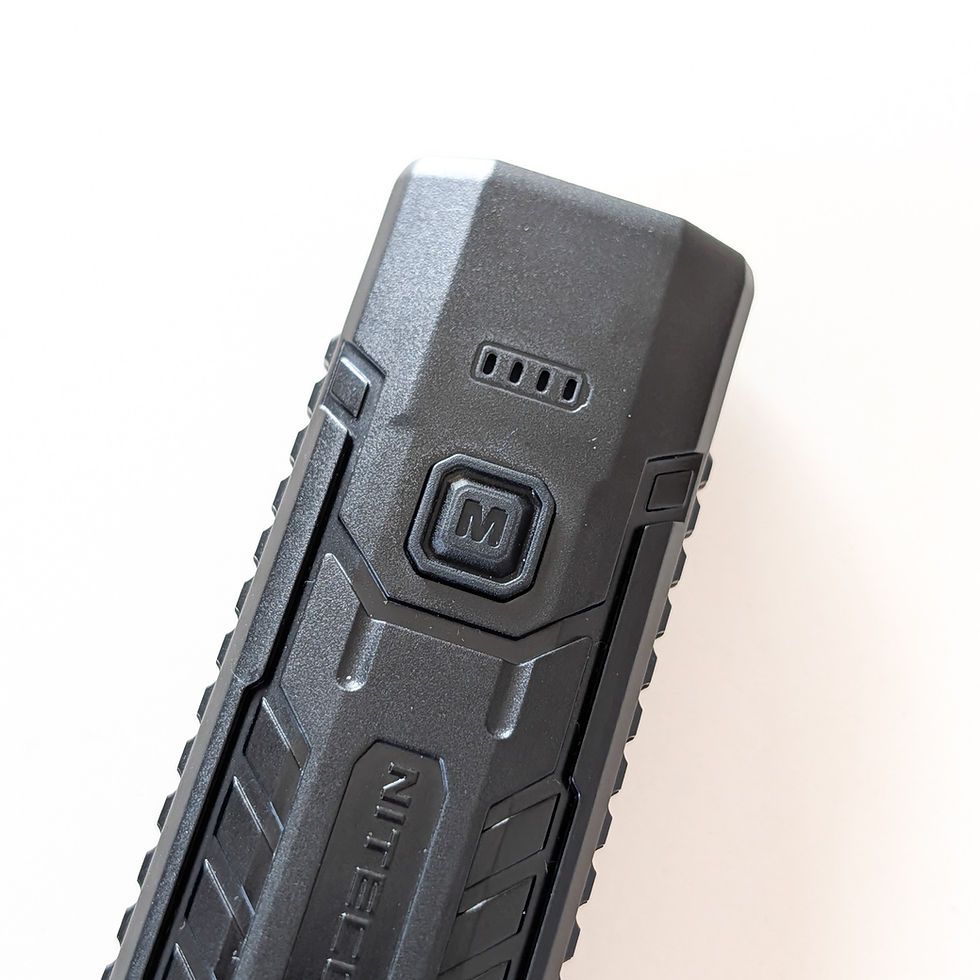
There are two switches, a side e-switch (M switch) near the head, and a tail reverse clicky switch. More on the user interface in the next section. The EDC07 uses an internal, non-user replaceable 1500mAh Li-poly battery. This is less than half of the capacity of cylindrical 18650 battery flashlights, but due to high efficiency LED drivers, the runtimes are still pretty decent. The charging is performed via USB-C and took less than 90 mins to fully charge.
As I'm a light painting and night photographer, I also review lights from the perspective of a photographer. The EDC07 has great potential for the illumination side of light painting photography due to the ability to switch between correlated colour temperatures (CCTs). The EDC07 is however unsuitable for creating light trails as the cylindrical shape does not work well with cone shaped light painting tool connectors. There is no tail magnet for attaching to objects.


User Interface
The Nitecore EDC07 has a fairly simple user interface (UI), with a side e-switch (M switch) for changing modes, and a recessed reverse clicky tail switch for on/off/momentary.
The tail switch is used for on/off with a single click. Unlike the UT27 MCT, the EDC07 turns on into the previously used mode with last mode memory - yay! Single click of the side switch when on changes the brightness level Low > Medium > High > Turbo > Low. Long press of the side switch changes the CCT 6500K > 4500K > 3000K > 6500K.
Activating the Ultra Low, Strobe, or SOS modes is a little bit different. The user needs to hold the side switch whilst turning the light on. The light then cycles through Ultra Low > Strobe > SOS > Ultralow. This mode will then be memorised for on/off until the side switch is pressed, which advances to Low Mode. These modes also use the last used CCT mode. The Strobe is alternating frequency.
The light has 4 stage battery level indicators (25% increments), which are very useful. There is no lockout function, however due to the design of the tail switch, accidental activation would be very difficult.
Overall, the UI is easy to use, and I like the last mode memory for all modes, and ability to easily switch between CCTs. Some users may prefer TV remote shaped lights with a side switch only user interface for more ergonomics (i.e. not having to change hand position between using each switch). Unusually, the light can memorise strobe which would be useful for light painting photography if the light was cylindrical and had a constant frequency strobe.

Optics, Beam, and Runtime
The Nitecore EDC07 utilises twin quad core NiteLab MCT UHE LEDs. These LEDs have 2 high efficiency, low CRI cool white cores, and 2 warm white high CRI cores. These are all placed in plastic TIR optics, with no glass front lens. Both of the main optics illuminate at the same time. It is presumed that the LED driver is a constant current buck driver. The CCT options are 6500K 73 CRI cool white, 4500K 83 CRI neutral white, and 3000K 97 CRI warm white.

Tested brightness in lumens (5 secs after the light is turned on):
Cool Ultra Low: 1.1 lm
Cool Low: 16 lm
Cool Medium: 86 lm
Cool High: 331 lm
Cool Turbo: 1581 lm
Neutral Ultra Low: 0.9 lm
Neutral Low: 13 lm
Neutral Medium: 71 lm
Neutral High: 284 lm
Neutral Turbo: 1453 lm
Warm Ultra Low: 0.9 lm
Warm Low: 11 lm
Warm Medium: 56 lm
Warm High: 217 lm
Warm Turbo: 1044 lm
The tested brightness in lumens was generally slightly higher than the specified brightness, and well within a +/-10% margin of error.
The rated runtimes for each mode from Turbo to Very Low are 2h15mins, 2h45mins, 11h, 52h, and 360h. Medium and High runtimes were close to specification, but Turbo was in the 1h45m to 2h range. Gradual step down starts almost immediately after turning the light on, which made it very tricky to test, and is a little disappointing compared to the ArkPro family which can sustain turbo for a few minutes. Sustained brightness is at High mode brightness, and is pretty decent for a light with a plastic shell, at 210-330 lumens. The light stays within safe to hold temperature limits.

The EDC07's Ultra Low mode, and ability use Turbo with all three CCTs is an improvement over the otherwise excellent UT27 MCT headlamp.
Peak beam intensity:
Cool Ultra Low: 5 lux/1m
Cool Low: 75 lux/1m
Cool Medium: 393 lux/1m
Cool High:1506 lux/1m
Cool Turbo: 7215 lux/1m
Neutral Ultra Low: 4 lux/1m
Neutral Low: 61 lux/1m
Neutral Medium: 325 lux/1m
Neutral High: 1291 lux/1m
Neutral Turbo: 6608 lux/1m
Warm Ultra Low: 4 lux/1m
Warm Low: 50 lux/1m
Warm Medium: 256 lux/1m
Warm High: 987 lux/1m
Warm Turbo: 4747 lux/1m
The beam profile is very floody, but with adequate throw to see into the distance. This general purpose beam is useful for most of this light's intended use cases. My Opple Light Master 3 Pro does over-estimate lux by around 25%, so the actual peak beam intensity is again close to specification.
Tested correlated colour temperature (CCT Kelvin), colour rendering index (CRI Ra), and tint (DUV):
Cool Low: CCT 5389K, CRI 71.3 Ra, Tint +0.0049 DUV.
Cool Turbo: CCT 5918K, CRI 72.8 Ra, Tint -0.0006 DUV.
Neutral Low: CCT 4132K, CRI 85.9 Ra, Tint +0.0005 DUV.
Neutral Turbo: CCT 4388K, CRI 83.0 Ra, Tint -0.0005 DUV.
Warm Low: CCT 2970K, CRI 97.4 Ra, Tint +0.0011 DUV.
Warm Turbo: CCT 3217K, CRI 95.4 Ra Tint +0.0050 DUV.
Cool white was warmer than specified (5500-6000K rather than 6500K) which is good, with a CRI in the low 70s. Neutral white is a much more pleasant beam for the eyes with a CRI at around 85. This is better than many household LED lightbulbs at rendering colours. Warm white had an impressive CRI of above 95. I much prefer to use warm white when camping as it is less harsh on the eyes. The neutral and warm white outout options give this light a big tick in my opinion!
Pulse Width Modulation (PWM) was not detected in any mode.
CCT comparison. Olight ArkFeld Pro is the control light on the left of each photo. Nitecore EDC07 is on the right of each photo in 6500K, 4500K, and 3000K.


Conclusion
Positives:
Excellent value for money.
Simple user interface.
Last mode memory for all modes.
Momentary tail switch.
Choice of 3 different CCTs and CRIs in one light.
Moonlight (Ultra Low) mode.
Good sustained brightness.
USB-C charging.
Good ergonomics.
Negatives:
Some users may prefer a side switch only user interface.
No glass lens - prone to scratches.
Rapid brightness step-down.
No tail magnet.
The TV remote control shaped EDC flashlight market is quite crowded, however the Nitecore EDC07 is one of only a few options with high CRI LEDs which are much easier on the eyes. The Nitecore EDC07 is a standout product in this market due to being good value for money, and having the unique ability to switch between warm, neutral, and cool white, as well as being very bright! This makes the light a compelling choice for night and light painting photographers, as well as many other use cases including camping, and general purpose EDC use.


Comments