.jpg)
Flashlight Review: Olight ArkPro Lite
The new Olight ArkPro series is the latest iteration of the Arkfeld range of rectangular shaped flashlights/torches. The ArkPro series includes the ArkPro (flood, spot, UV, laser), ArkPro Ultra (flood, spot, UV, laser) with fancier aluminium, and the subject of this review, the ArkPro Lite (general purpose beam, UV, red).
Disclaimer
The Olight Arkfeld Pro was purchased with my own funds.
ArkPro Olight USA - 10% off with code: 10OFFTD
ArkPro Olight Australia - 10% off with code: OLT2026

Construction and Design
Olight are one of the most well known consumer flashlight manufacturers. The Arkfeld was one of the first rectangular (TV remote control) shaped flashlights, which many other manufacturers have since copied. The Arkfeld line has evolved into the ArkPro series of lights, with some changes to emitter options. The ArkPro Lite is the smallest and cheapest light of this range, and is 9mm shorter than the older Arkfeld Pro. This actually makes it slightly less ergonomic due to how it sits in the hand. The ArkPro Lite has a significant difference to previous Arkfeld iterations, in that it has a Red LED, instead of a Laser. This is potentially more useful for many users. Interestingly, in Australia at least, Olight are now calling the "Laser" a "Green Beam". I'm not sure for the reason behind this, but it may be for customs or regulatory reasons as Laser pointers are for most purposes banned without due reason in some Australian states.
Back to the ArkPro Lite, the main specifications are as follows:
1,200 lumen cool white LED
1000mW 365nm UV LED
40 lumen 620nm Red LEDs (2 LEDs)
Integrated battery capacity: 1,350mAh
Construction: Aluminium Alloy (6061)
Weatherproofing: IPX7
Dimensions: 111x27x16mm
Weight: 105g
Charging: USB-C and MCC magnetic charging
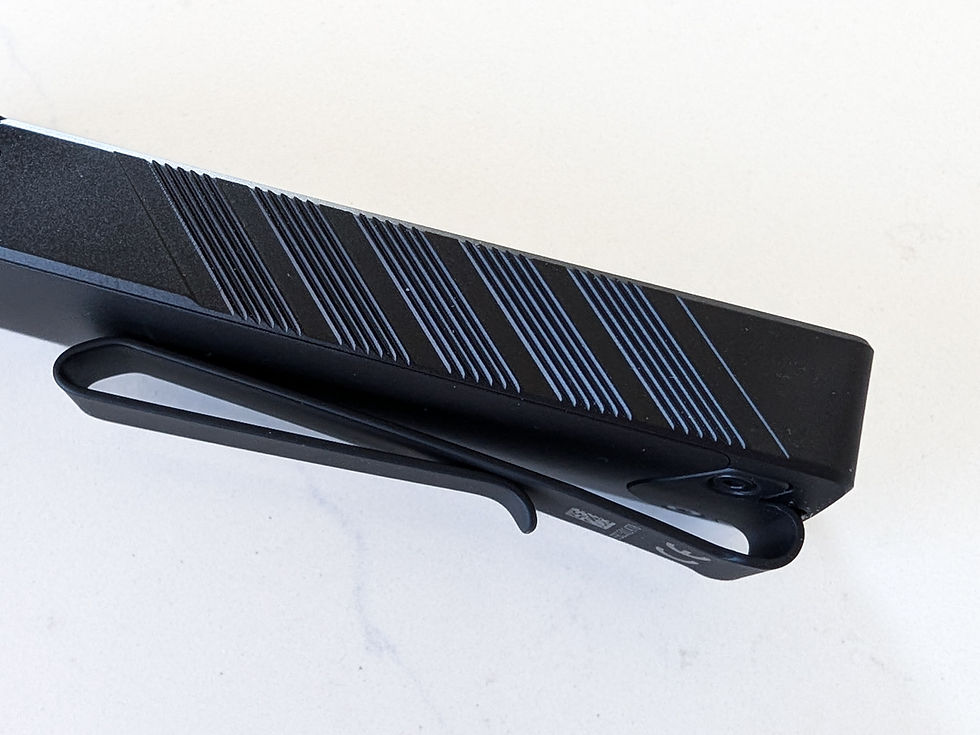
Due to the rectangular shape, the ArkPro Lite fits into pockets much more easily than 18650 tube lights. The light has a decent two way pocket clip. The ArkPro Lite has a weatherproof IPX7 rating.
The ArkPro Lite arrived in an Olight branded box. The light comes with an Olight MCC charging cable, safety guide, and instructions. At the time of writing the ArkPro Lite was only available in Black, unlike the other ArkPro models which have more options. The Arkfeld Pro usually retails for AU$123.95, though I purchased it during one of Olight's many sales for AU$99.16.
The ArkPro range continues to use Olight's proprietary MCC magnetic charging system, but can now thankfully also be charged by USB-C using a covered charging port at the head end of the light. The plastic cover flips, which I actually prefer to rubber or silicone plugs. The ArkPro Lite's internal Lithium Polymer battery has a capacity of 1,350mAh. This is a small downgrade from the Arkfeld Pro, and less than half of the capacity of 18650 lights. The battery is not user replaceable, however Olight do have an impressive lifetime warranty that includes the battery. Charging time was slightly more than 90 mins.
As I'm a light painting and night photographer, I assess how useful flashlights are for these use cases. Due to the non-cylindrical shape, the ArkPro series are not compatible with any light painting systems. There are some 3rd party diffusers available. Due to the triple emitters, it does have some niche uses for the illumination side of light painting and night photography. I often use the moonlight mode to illuminate where I have left my equipment, without stray light affecting my photos.




User Interface
The Olight ArkPro LIte has the same user interface (UI) as the Arkfeld Pro line, which utilises a selector switch for the emitter, and a push button switch for on/off, and hold for changing brightness levels. Despite lots of functionality, the user interface is very simple to use:
Selector switch for UV, White Light, and Red.
5 White Light brightness levels - Moonlight, Low, Medium, High, Turbo.
Last mode memory for Low, Medium, and High. (High not memorised after 1 minute off-time).
2 brightness levels for UV (no last mode memory, always turns on in Low)
2 brightness levels and SOS for Red (no last mode memory, always turns on in Low).
Direct access to Moonlight from Off (long press).
Turbo and Strobe (13Hz)/SOS can be accessed from On or Off via double and triple click respectively.
4-level brightness level and battery charge indicators around button.
Timer and lockout functionality.

Beam, Output, and Runtime
The Olight ArkPro Lite has a 1,200 lumen cool white LED in a TIR optic, two Red LEDs, and a UV LED in a reflector. Olight do not state which LEDs are used, though I would guess that the cool white LED is still a Osram Osconiq P 3737 (P9).

Claimed / Measured Brightness:
Turbo/Strobe - 1200 / 1130 lumens (step down to high between 3-4mins).
High - 350 / 318 lumens
Medium - 60 / 54 lumens.
Low - 15 / 11.5 lumens.
Moonlight - 1 / 1.1 lumen.
UV 365nm - 1000mW/360mW (not tested)
Red 620nm - 40lm/5lm (not tested)
Claimed/measured Peak Beam Intensity (note: my light meter tends to overestimate by 25%):
Turbo - 2,225cd (94m) claimed / 3,144cd (112m) measured
High - 886cd (59m) measured.
Medium - 151cd (24m) measured.
Low - 32cd (11m) measured.
Moonlight - 3cd (3.5m) measured.
Lumen output within 10% of claimed specifications, with all modes being measured slightly lower than specification. The maximum white light brightness of 1,130 lumens is pretty impressive for the light's size, though slightly lower than the Arkfeld Pro. Due to Olight's efficient LED drivers, the ArkPro Lite managed to sustain this maximum brightness for more than 3 minutes. After step down, the sustained brightness is still reasonable for the light's dimensions, and the light never gets excessively hot. The brightness levels are well spaced, though 60lm Medium is a bit of a downgrade from the Arkfeld Pro's 100lm. Moonlight mode is welcome as this is an EDC flashlight.
Whilst the light has a "general purpose beam" with flood and a hotspot, it is still at the very floody end of the scale. The peak beam intensity/throw is rather unimpressive, and I'm not sure if a domed LED was the right choice.
The two Red LEDs use a wavelength of 620nm, which is more at the orange end of the red scale. Whilst it is good to see a Red LED on an Arkwhatever light, as a night photograoher I would have preferred a 660nm Deep Red which is better for preserving night sight. There are two Red brightness options 40 lumens and 5 lumens. This is adequate for most uses. The Red LEDs have a floody beam profile.
The UV emitter is 365nm, with no ZWB filter, making the beam easily visible. There are 2 brightness settings. Due to a more defined hotspot, and slightly higher current, the UV light appears to be visually brighter than on the Arkfeld Pro.
Claimed Runtimes:
Turbo - 138mins (4+134mins)
High - 185mins (155+30mins)
Medium - 16hours.
Low - 54mins.
Moonlight - 10days.
UV High - 285mins (5+280mins).
UV Low - 6hours
Red High - 5hours30mins
Red Low - 39hours.
Red SOS - 11hours.
Runtimes on Turbo and High were tested to be within +/-10% of specification. I have not tested the other modes, but generally Olight are very honest with their specifications.
White light hotspot correlated colour temperature (CCT), colour rending index (CRI Ra), and tint/DUV:
Turbo - CCT 5902K, CRI 69.9 Ra CRI, Tint +0.0041 DUV.
High - CCT 5762K, CRI 69.2 Ra CRI, Tint +0.0060 DUV.
Medium - CCT 5688K, CRI 68.6 Ra, Tint +0.0070 DUV.
Low - CCT 5667K, CRI 69.5 Ra, Tint +0.0078 DUV.
Moonlight - unable to test.
For an EDC category flashlight aimed at near field illumination, I would much prefer a less efficient high CRI LED with more neutral tint. Unfortunately, most of Olight's customers just want more lumens, so that's what they get. However, Olight do have a high CRI LED in some models such as the Perun 3 Mini.
No Pulse Width Modulation (PWM) was detected visually, or by my phone camera.
Olight ArkPro Lite beam profile photos for White, Red, and UV LED emitters.
Conclusion
Positives:
Good build quality.
Good maximum brightness/size.
Versatile light with White Light, UV, and Red options.
Fairly simple user interface.
USB-C internal charging option
Constant frequency strobe.
More pocketable and ergonomic than cylindrical flashlights.
Good battery charge remaining indicator.
Moonlight mode.
Lifetime warranty.
Negatives:
No high CRI version.
Limited throw.
Deep Red would be more preferable to 620nm Red for night photographers.
Some downgrades from the Arkfeld Pro (lower max brightness, battery capacity, medium mode, less ergonomic).
The older Arkfeld Pro has been my favourite EDC light for night walks for a couple of years, and the ArkPro Lite will carry on this tradition, with a useful Red light instead of a Laser. The light is easy to use, fits easily into pockets, and has decent brightness for the light's size. Whilst the USB-C input is a useful addition, there are a few minor downgrades from the Arkfeld Pro, the most notable being that light is less ergonomic to hold due to the shorter length.
ArkPro Olight USA - 10% off with code: 10OFFTD
ArkPro Olight Australia - 10% off with code: OLT2026


Comments